
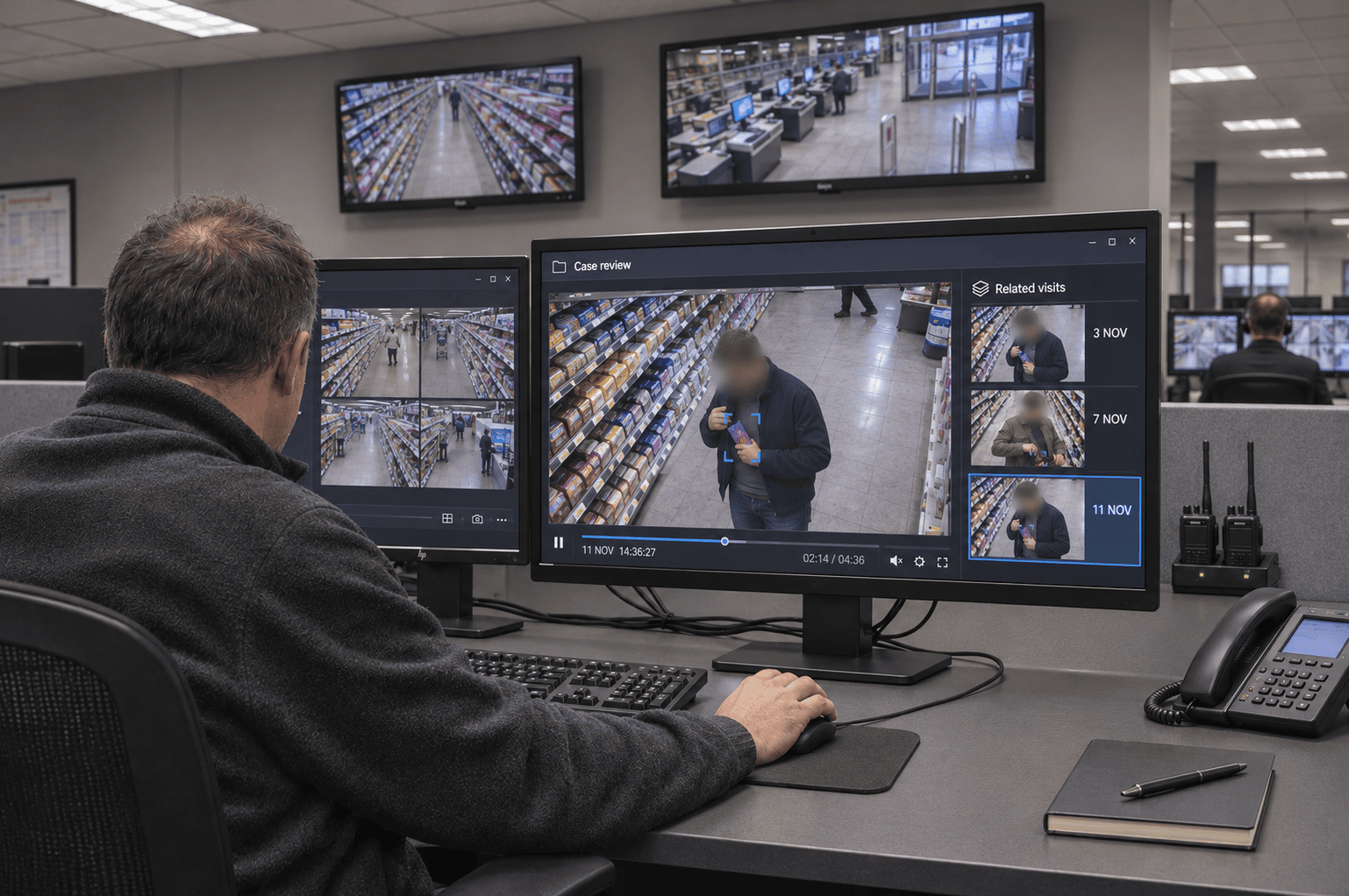
A repeat offender can become a familiar face long before their theft becomes a familiar pattern. They may visit regularly, buy some products and leave with others unpaid. Unless the incidents are detected and connected, the retailer may never see how much that one person is taking over time, which can easily become thousands of dollars in stolen goods.
That is the challenge behind repeat offender detection. A store needs a way to discover recurring theft, including when nobody has yet identified the person responsible or added them to a watchlist.
Why the discovery matters
Retail leaders have made clear why repeat offending deserves attention. Giving evidence to UK MPs in March 2025, Co-op’s Paul Gerrard described the substantial share of retail crime associated with “a relatively small number of prolific offenders”. [1]
Trigo’s own internal data shows a similarly concentrated pattern: roughly 2.5% of shoppers account for approximately 60% of stolen goods. [2]
For loss prevention teams, that concentration makes discovery a business priority. A series of small thefts can become a significant source of loss. If those visits remain separate in the evidence, the cumulative impact can remain hidden too. Understanding who is repeatedly responsible for loss helps teams decide where to spend their investigation time.
The work behind knowing your repeat offenders
In the US, the work of recognising repeat offenders can involve retailers sharing information themselves. The Wall Street Journal reported in April 2026 that National Supermarket Association members use a WhatsApp group to circulate shoplifter photos and alert one another. That cooperation serves a practical purpose, but it starts after someone has noticed the theft. The earlier challenge remains: discovering the incidents that have not yet brought someone to the retailer’s attention. [3]
Once incidents have been detected, connecting them is essential to revealing a repeat pattern.
A May 2026 account of Dorset Police’s Operation Shopkeeper describes the problem plainly: “Each offence was investigated in isolation.” Without links between reports, repeat and travelling offenders escaped detection across different locations. [4]
Together, these accounts illustrate the work involved in sharing information and connecting individual thefts. For loss prevention teams, the value comes from turning separate incidents into a clearer picture of recurring loss.
A watchlist starts with someone already known
A watchlist can help a retailer recognise someone who has previously been documented. Bunnings New Zealand, for example, describes a system limited to known offenders associated with prior serious harm including high-value theft, with enrollment following a review process. That is a defined purpose with a clear starting requirement: an earlier incident must have brought the person to the retailer’s attention. [5]
For a retailer trying to uncover recurring theft, the earlier question is how that happens. Someone has to detect the incident, establish what happened and connect it with other visits. A list populated from discovered incidents cannot, on its own, tell a retailer about theft that has never been discovered.
The opportunity is to make that discovery less dependent on an employee first noticing a theft or recognising a familiar person.
Following the product to uncover the pattern
Trigo starts with the merchandise, applying the familiar loss prevention principle of “follow the product”. Using existing CCTV and computer vision, it tracks products through the store to establish what was picked up and whether it was paid for. The investigation begins with evidence of theft, without requiring the person to be on a pre-existing watchlist.
Taking a privacy-forward approach, Trigo’s Theft Analysis Engine connects theft incidents across visits and assembles the supporting video into cases. This helps loss prevention teams uncover previously unknown repeat offenders, understand the cumulative impact of their activity and prioritise the cases driving the greatest losses.
Trigo reveals 15× more repeat offenders, expanding the picture beyond the people already known to store teams. A theft that appears minor on one visit can take on new significance when connected to a pattern of recurring losses.
For investigators, that means a clearer view of who is repeatedly stealing, what they are taking and how much those visits add up to. It gives teams the evidence to decide which cases to pursue and where to focus their time.
Explore Trigo’s Theft Analysis Engine.
Source References
[1] UK Parliament, Crime and Policing Bill, 27 March 2025, Q42
[2] Daniel Gabay, You Don’t Need Their Face, Retail Technology, 8 September 2026
[3] James Fanelli, The Wall Street Journal, 22 April 2026 (republished by Mint)
[4] College of Policing, Operation Shopkeeper, Description section
[5] Bunnings New Zealand, facial recognition information, updated 7 July 2026